When you consider a name for your son, you’re not just picking a label; you’re often choosing a legacy, a whisper of identity that will echo through his life. For many Christian families, the process is imbued with deeper spiritual significance, turning to christian male names and meaning as a wellspring of intention and aspiration. These names, rooted in biblical narratives and ancient languages, carry profound spiritual meanings and stories of faith, strength, and divine purpose that can inspire a lifetime.
At a Glance: Crafting a Meaningful Name Choice
- Discover Deep Roots: Understand the Hebrew, Greek, and Latin origins of Christian names and their spiritual weight.
- Connect to Biblical Virtues: See how names embody traits like strength, leadership, faith, or divine grace.
- Explore Rich Narratives: Learn the stories behind significant biblical figures to find names that resonate with character and calling.
- Navigate Practical Choices: Gain insights into balancing spiritual meaning with modern appeal and sound.
- Answer Key Questions: Address common dilemmas and misconceptions about choosing a Christian male name.
- Empower Your Decision: Get actionable steps to confidently select a name that blesses your son with a powerful heritage.
The Enduring Spiritual Weight of a Christian Name
Choosing a name from the rich tapestry of Christian tradition is more than a cultural nod; it’s an act of faith. These aren’t just names; they are ancient prayers, prophecies, and declarations. Each name often carries with it the character of a biblical figure, a divine attribute, or a profound truth about God’s relationship with humanity. It’s an opportunity to bestow a hopeful blessing, a guiding principle, or a reminder of divine presence upon your child from day one.
Consider the patriarch Abraham, whose name means “father of many nations.” His life story is a testament to trust, humble leadership, and enduring faith, making his name a powerful declaration for a son. Similarly, the name Emmanuel, meaning “God with us,” isn’t just a beautiful sound; it’s a profound theological statement, a prophecy of Christ’s presence and God’s nearness.
Unpacking Origins: Hebrew, Greek, and Latin Roots
The majority of Christian male names trace their origins to three primary languages, each contributing unique flavors and depths of meaning:
- Hebrew: The language of the Old Testament, rich with names that are often direct prayers or descriptions of God’s character and interaction with humanity. These names frequently end in “-el” (God) or “-iah” (Yahweh/Lord).
- Greek: Prominent in the New Testament, Greek names often describe character traits, roles, or derive from Greek mythology, later adopted by early Christians for their inherent virtues.
- Latin: The language of the Roman Empire, Latin names often reflect Roman virtues, status, or connections to early Roman Christians.
Understanding these linguistic roots provides a deeper appreciation for the layers of meaning embedded within each name. For instance, while a name might sound pleasing, its original Hebrew meaning might reveal a powerful truth about divine assistance, like Azariah, “helped by God,” or Eleazar, “God has helped.” For more broad biblical name insights, you can Find strong biblical names that resonate with these deep historical and spiritual contexts.
Names Reflecting Character and Calling: A Thematic Exploration
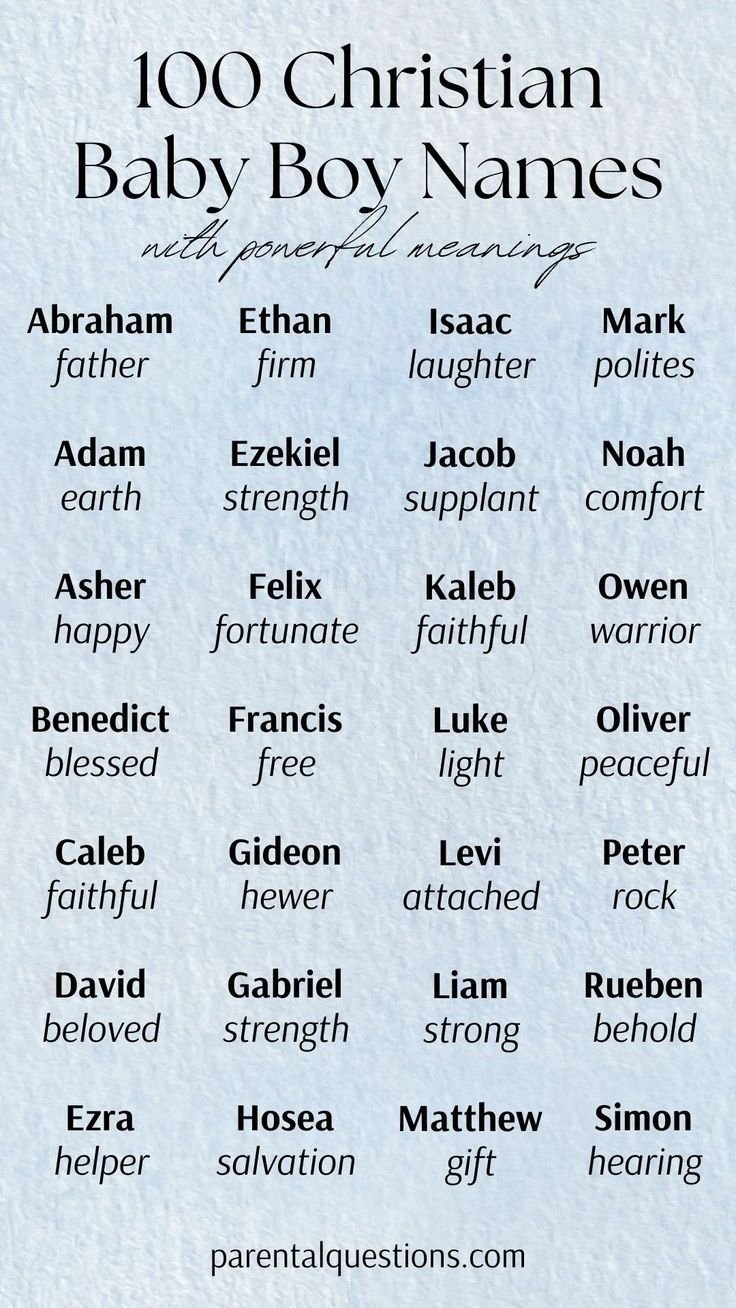
Let’s dive into specific categories of Christian male names, revealing their spiritual meanings and the biblical narratives they carry. This isn’t just a list; it’s a thematic journey to find a name that aligns with the hopes and prayers you hold for your son.
Names of Strength & Leadership
These names evoke fortitude, command, and the ability to guide others, often reflecting figures who led nations or movements.
- Aaron (Hebrew, “exalted” or “mountain of strength”): Moses’s brother, the first high priest, symbolizing eloquence and strong leadership.
- Abraham (Hebrew, “father of many nations”): The patriarch of faith, a model of trust, ethics, and humble leadership.
- Barak (Hebrew, “lightning”): A humble, bold, and fearless man who helped Deborah achieve victory, signifying decisive action.
- Benjamin (Hebrew, “son of my right hand”): Jacob’s youngest son, representing beloved status, strength, and confidence, founding one of Israel’s tribes.
- Boaz (Hebrew, “swiftness” or “strength”): A kinsman-redeemer who showed kindness and responsibility, symbolizing steadfastness.
- Caleb (Hebrew, “devotion to God” or “whole-hearted”): A faithful spy who trusted God’s promises, embodying unwavering loyalty and courage.
- David (Hebrew, “beloved”): Israel’s greatest king, an ancestor of Jesus, known for his leadership, courage, and heart for God.
- Gideon (Hebrew, “mighty warrior”): A judge who delivered Israel with a small army, demonstrating faith and strategic strength.
- Joshua (Hebrew, “the Lord is salvation” or “the Lord saves”): Moses’s successor, who led Israel into the Promised Land, a symbol of divine guidance and conquest.
- Moses (Egyptian, “drawn out of water”): The great deliverer who led Israel from slavery, representing freedom and divine law.
Names of Faith & Devotion
These names are associated with individuals who demonstrated profound trust, righteousness, and commitment to God, often against great odds.
- Abel (Hebrew, “breath” or “son”): Adam and Eve’s second son, signifying righteousness and respect for God through sacrifice.
- Daniel (Hebrew, “God is my judge”): A prophet known for his unwavering faith, wisdom, and miraculous deliverance in Babylon.
- Enoch (Hebrew, “dedicated”): A man who walked so closely with God that he was taken to heaven without dying, symbolizing deep devotion.
- Isaac (Hebrew, “laughter”): Abraham’s promised son, representing God’s faithfulness and the joy that comes from His promises.
- Job (Hebrew, “persecuted” or “hated”): A righteous man who remained faithful through extreme suffering, embodying perseverance and trust.
- Jonathan (Hebrew, “gift of God”): King Saul’s son and David’s loyal friend, exemplifying covenant friendship and selfless loyalty.
- Josiah (Hebrew, “the Lord supports” or “the Lord heals”): A young king who brought spiritual reformation to Judah, showing commitment to God’s law.
- Noah (Hebrew, “rest”): The patriarch who built the ark, signifying obedience, hope, and new beginnings.
Names Signifying Divine Grace & Help
These names often point directly to God’s character as a helper, deliverer, or source of strength, reflecting His active involvement in human lives.
- Azariah (Hebrew, “helped by God”): A faithful priest who confronted King Uzziah, demonstrating courage born from divine support.
- Eliezer (Hebrew, “God is my help”): A name borne by Moses’ son, and Abraham’s servant, signifying divine assistance in journeys.
- Elijah (Hebrew, “Yahweh is God”): A powerful prophet who confronted false gods, demonstrating God’s supreme power.
- Elisha (Hebrew, “God is salvation”): A prophet who succeeded Elijah, performing numerous miracles through divine power.
- Emmanuel (Hebrew, “God with us”): A prophetic name for Jesus, representing the very presence of God among humanity.
- Ezra (Hebrew, “help”): A priest and scribe who led spiritual revival and rebuilt Jerusalem’s walls, symbolizing divine aid in restoration.
- Gabriel (Hebrew, “God is my strength”): The archangel who announced Jesus’s birth, a messenger of divine power and purpose.
- Isaiah (Hebrew, “salvation of the Lord”): A major prophet who foretold Christ’s coming, emphasizing God’s plan of redemption.
- Joel (Hebrew, “Yahweh is God” or “the Lord is God”): A prophet who foretold the outpouring of the Holy Spirit, highlighting divine revelation.
- John (Hebrew, “God is gracious”): A beloved disciple and author of Revelation, embodying divine grace and love.
- Joseph (Hebrew, “he will add” or “God will increase”): Jesus’s earthly father, and Jacob’s son who saved Egypt, signifying divine provision and increase.
- Lazarus (Hebrew, “God has helped”): The man Jesus raised from the dead, demonstrating miraculous divine power.
- Matthew (Hebrew, “gift of God”): A tax collector turned apostle, whose name represents God’s unexpected grace.
- Nehemiah (Hebrew, “comforted by God”): A leader who rebuilt Jerusalem’s walls, symbolizing divine comfort and resilience in service.
- Paul (Latin, “small” or “humble”): The greatest missionary, whose journey transformed him from persecutor to apostle, representing divine transformation and humility.
- Peter (Greek, “rock”): Jesus’s disciple, a foundational figure in the early church, symbolizing divine strength and steadfastness.
Names of Joy & Blessing
These names carry connotations of happiness, favor, and abundance, reflecting God’s blessings.
- Asher (Hebrew, “happy” or “blessed”): One of Jacob’s twelve sons, representing joy, abundance, and positive leadership.
- Felix (Latin, “happy” or “fortunate”): A Roman governor, but the name itself speaks of good fortune and joy.
- Gaius (Latin, “rejoice”): A hospitable Christian mentioned in Paul’s letters, embodying joy in fellowship.
- Judah (Hebrew, “praised”): Jacob’s fourth son, an ancestor of Jesus, whose name is a celebration of praise and royalty.
Names of Prophets & Apostles
These names connect directly to the foundational figures of biblical history, those who delivered God’s message or spread the Gospel.
- Amos (Hebrew, “carried by God”): A prophet who spoke boldly about justice, representing divine burden and righteous indignation.
- Andrew (Greek, “manly” or “brave”): The first disciple called by Jesus, embodying pure dedication and strength.
- Bartholomew (Aramaic, “son of Talmai”): One of Jesus’s apostles, instrumental in establishing early Christianity.
- James (Hebrew, “supplanter”): Jesus’s disciple and brother, an early church leader, symbolizing profound wisdom and leadership.
- Jeremiah (Hebrew, “appointed by God”): A prophet called from youth to speak God’s truth courageously, representing divine calling.
- Luke (Greek, “light-giving”): A physician who wrote a Gospel and Acts, symbolizing enlightenment and compassionate service.
- Malachi (Hebrew, “my messenger”): The last Old Testament prophet, foretelling future divine intervention.
- Mark (Latin, “warlike”): Author of the Gospel, a companion of Peter and Paul, symbolizing evangelistic zeal.
- Micah (Hebrew, “who is like the Lord”): A prophet who foretold Christ’s birthplace, emphasizing divine uniqueness.
- Nathanael (Hebrew, “gift of God”): A disciple praised by Jesus as having no deceit, representing purity and truth.
- Philip (Greek, “lover of horses”): An apostle who evangelized Ethiopia, symbolizing zeal and openness to the Spirit.
Beyond the Meaning: Practical Considerations for Choosing
While spiritual meaning is paramount, practicality plays a role in how a name lives in the real world.
- Sound and Flow: How does the name sound with your surname? Say it aloud. Does it flow well, or does it create an awkward rhythm? A name like “Caleb” might pair beautifully with a shorter surname, while “Bartholomew” might need a simple, single-syllable last name.
- Modern vs. Traditional Appeal: Some biblical names feel timeless (e.g., David, Joseph), while others are distinctly ancient (e.g., Abihu, Arphaxad). Consider if you prefer a classic, common, or unique name. There’s beauty in both.
- Potential Nicknames: What are the natural diminutives or nicknames? Are you comfortable with them? “Samuel” easily becomes “Sam,” “Benjamin” to “Ben.” Sometimes, a name without an obvious nickname is precisely what a parent wants.
- Personal Connection: Does the story of the biblical figure resonate with your family’s values, experiences, or hopes? A name like “Isaac” might be especially poignant for parents who have waited long for a child, echoing his story of “laughter” after years of barrenness.
A Practical Guide to Choosing Your Son’s Christian Name
Making this decision can feel momentous. Here’s a simplified approach to guide you:
- Reflect on Desired Virtues: Start by listing 3-5 character traits or spiritual aspirations you deeply desire for your son (e.g., strong faith, wise leadership, compassion, joy). This helps narrow down the vast options.
- Explore Biblical Stories Thematically: Using the categories above (Strength, Faith, Grace, Joy, etc.), delve into the biblical narratives behind names that align with your desired virtues. Read their stories in the Bible. Does the figure’s journey inspire you?
- Consider Sound and Adaptability: Shortlist names that feel right in meaning. Then, test them aloud with your surname. Think about potential nicknames. Write them down.
- Prayerful Consideration: Take your top 2-3 choices to prayer. Ask for discernment and peace about the name. Sometimes, a name will simply “click” and feel right for your son.
- Seek Wise Counsel (Optional): Discuss your final choices with a trusted spouse, family member, or spiritual mentor. They might offer valuable perspectives you hadn’t considered.
Case Snippet: Sarah and Mark wanted a name that signified “strength in faith” for their son. They loved the story of Daniel, who stood firm in his beliefs. While “Daniel” was a strong contender, they also explored “Caleb,” meaning “devotion to God,” whose wholehearted trust against giants resonated deeply. They ultimately chose Caleb, appreciating both its meaning and its slightly less common, yet still classic, sound.
Common Questions About Christian Male Names
Q: Do Christian names have to be from the Bible?
A: Not exclusively. While most traditional Christian names are biblical, “Christian names” also encompass names derived from saints, virtues (e.g., Clement), or culturally adopted names by Christian communities over centuries (e.g., Patrick). The core is often the spiritual intention and heritage behind the choice.
Q: Is it okay to choose a name with a ‘negative’ biblical figure but a good meaning?
A: This is a nuanced area. While names like Achan (“trouble”) or Ahab (“father’s brother,” but associated with wickedness) carry clear negative connotations due to their biblical figures’ actions, others might be less clear-cut. For example, some names might have a powerful sound or an inspiring literal meaning, but the person who bore it in the Bible made poor choices (e.g., King Jeroboam, meaning “the people contend,” yet he led Israel into idolatry). Most parents opt for names tied to positive or redemptive figures to avoid unintended associations. Focus on the figure’s legacy as much as the literal meaning.
Q: How important is the original language meaning vs. modern interpretation?
A: Both are valuable. The original meaning (from Hebrew, Greek, Latin) provides historical depth, spiritual weight, and often connects directly to a biblical truth. Modern interpretation or common usage often shapes how a name is perceived today. For a Christian name, the original meaning is often prioritized because it ties the child directly to a rich spiritual heritage. However, ensuring it sounds pleasant and is pronounceable in contemporary society is also practical. Ideally, you find a name where both aspects align harmoniously.
Your Son’s Name: A Legacy of Faith
Choosing a name for your son is a profound act, a declaration of identity and hope. When you delve into the wealth of Christian male names and their meanings, you’re not just picking letters; you’re inviting a legacy of faith, strength, and divine purpose into his life. May your choice be a blessing, a daily reminder of the spiritual heritage you bestow upon him, guiding him on his unique journey with God.

- Christian Male Names and Their Deep Spiritual Meanings and Origins - November 24, 2026
- Strong Unique Biblical Boy Names Offering Deep Meaning and Enduring Faith - November 23, 2026
- Choose Christian Male Names with Enduring Biblical Meaning - November 22, 2026